
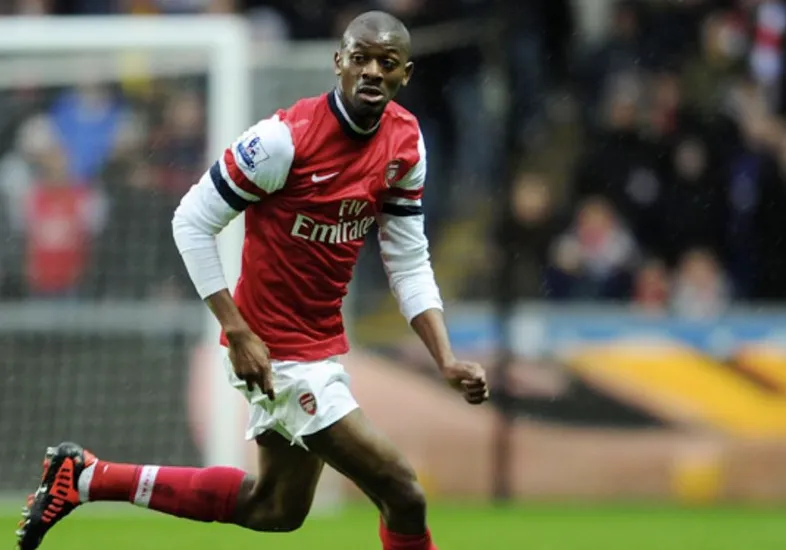
When Abou Diaby arrived at Arsenal as a 19-year-old, Arsène Wenger believed he had uncovered the next Patrick Vieira—a towering, technically gifted midfielder destined for greatness. But a devastating tackle in 2006 derailed what should have been a glittering career. Now, in a candid reflection, Diaby speaks about the psychological toll of being labeled “L’Homme de Verre”—the Man of Glass—and how that single moment altered the course of his life. Here, Jw7 brings you an exclusive analysis of his journey, the impact of injuries, and what his story means for modern football.
The Weight of a Nickname: Psychological Scars That Run Deep
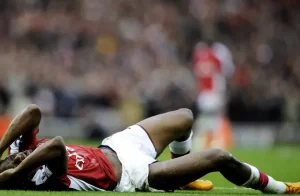
In an interview with the Daily Mail, Diaby admitted that hearing people reduce his career to a string of injuries is “painful, on a psychological level.” The midfielder, who made just 182 appearances for Arsenal over nine seasons—with only two in his final two years—suffered a reported 42 separate injuries between 2006 and 2015. But what the statistics don’t show is the daily grind of rehabilitation, the false dawns, and the emotional exhaustion.
“It can be painful, on a psychological level. They don’t know how much I give every day of my life to try and recover. But hey, what can I do? This is my life story,” Diaby said. For fans who only saw the man on the treatment table, it’s easy to forget that behind the injuries was a footballer who spent countless hours in physio rooms, fighting to return to the pitch.
The Moment That Changed Everything
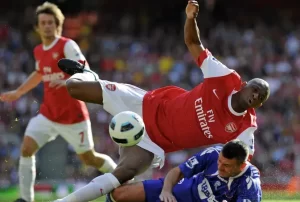
Diaby points to one incident as the root of his struggles: a reckless tackle from Sunderland’s Dan Smith in May 2006. The challenge fractured and dislocated his ankle, and Diaby believes it was “the moment that killed everything.”
“Before that, I’d never had a muscular injury, my lifestyle was good,” he explained. “That’s where it all came from. It gave me a big restriction on my ankle and I overcompensated with other parts of my body.”
This overcompensation led to a cascade of muscular problems, as his body tried to compensate for the ankle’s limitations. Medical experts have long noted that such biomechanical imbalances can create a domino effect of injuries, and Diaby’s case became a textbook example.
What Could Have Been: The Player Who Never Was
At his peak, Diaby was a phenomenon. Standing at 6’2″, he combined physical power with technical elegance—a rare blend that drew comparisons to Vieira. Wenger famously said after Diaby’s early performances that “he has the potential to be one of the best midfielders in Europe.”
But the injuries robbed him of his prime years. “If it happened when I was 28, things might have been different. Between 19 and 27, I would have had time to progress, play every week and be the player I should have been,” Diaby lamented.
For context, Vieira made over 400 appearances for Arsenal and won three Premier League titles. Diaby, by contrast, never managed a full season without at least one significant injury layoff.
Comparing Injury Records: Diaby vs. Other “What If” Players
| Player | Club | Appearances (2006-2015) | Major Injuries | Key Insight |
| Abou Diaby | Arsenal | 182 | 42 | Ankle fracture led to chronic muscular issues |
| Michael Owen | Liverpool/Real Madrid | 326 | 12 | Hamstring problems after rapid growth spurt |
| Ronaldo Nazário | Barcelona/Inter | 197 | 5 | Knee ligament tears after explosive style |
| Jack Wilshere | Arsenal | 197 | 18 | Ankle and knee issues from early overuse |
Diaby’s injury frequency is staggering, even among football’s most injury-prone stars.
The Road to Marseille: A Fresh Start
After leaving Arsenal in 2015, Diaby joined Marseille, where he managed 14 appearances and scored one goal. While not the revival many hoped for, it represented a personal victory—a chance to play again after years of frustration.
“The only thing I wish is that it had happened later in my career,” Diaby reflected. “But there is no resentment any more. I left it behind a long time ago.”
What Football Can Learn from Diaby’s Story
- Early injury prevention matters: Diaby’s case highlights how a single traumatic injury can create lifelong complications. Clubs now invest heavily in biomechanical screening and load management.
- Mental health support is crucial: The psychological impact of repeated injuries is often underestimated. Diaby’s openness about his struggles has helped normalize conversations about mental health in sport.
- Patience with young talents: Players like Diaby remind us that career trajectories are rarely linear. The “next big thing” label can become a burden when setbacks occur.
Final Thoughts: Beyond the “Man of Glass”
Abou Diaby’s career is often framed as a tragedy—a story of what might have been. But looking deeper, it’s also a story of resilience. To return from 42 injuries, to keep fighting when your body betrays you, requires a strength that statistics can’t capture.
As Diaby himself said, “This is my life story.” It’s a story that deserves more than pity—it deserves respect. For every fan who remembers his dazzling performances against Liverpool or his powerful runs through midfield, there’s a lesson in perseverance.
What do you think about Diaby’s legacy? Share your memories of his best moments in the comments below, and explore more in-depth football analysis on Jw7.
This article was written based on the original interview with Abou Diaby published by the Daily Mail on September 4, 2016. All quotes attributed to Diaby are sourced from that interview.
